
So, you’ve mastered the art of homebrewing kombucha. Your recipe is beloved, demand is growing, and you’re ready to scale from kitchen counter to commercial production. This exciting leap requires more than just bigger jars; it demands a professional, efficient, and reliable commercial kombucha brewing system. The right equipment is the cornerstone of your brand’s success, ensuring consistent quality, food safety, and operational scalability. Kombucha Brewery Equipment
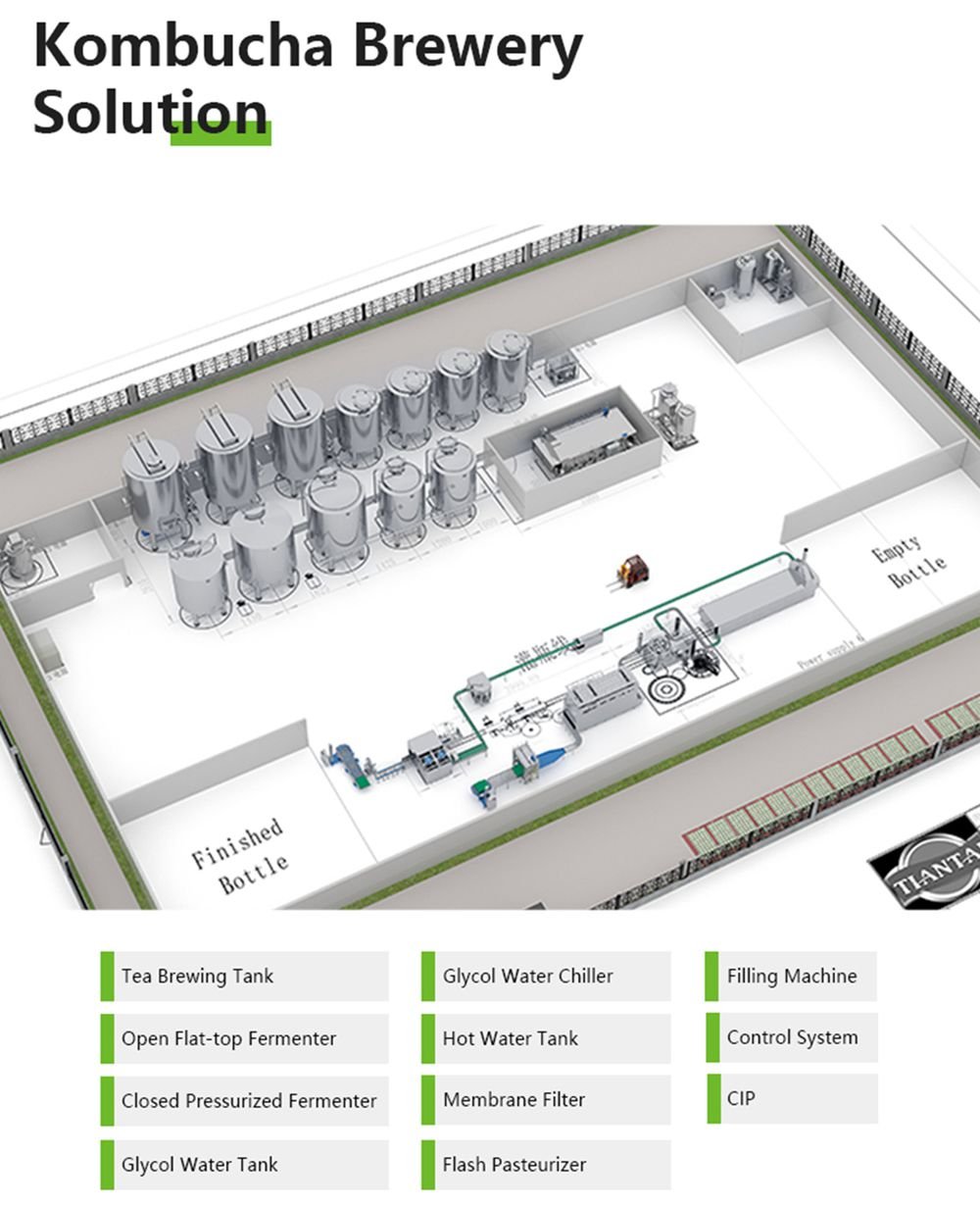
For commercial producers, every piece of equipment transitions from a simple tool to a critical component of your business infrastructure. As a manufacturer specializing in professional-grade stainless-steel kombucha equipment, we understand the unique needs of a production facility. Let’s explore the core systems that form the backbone of a successful commercial kombucha operation.
1. The Core: Primary Fermentation Tanks
This is where the alchemy happens. Commercial fermentation requires vessels that are durable, hygienic, and designed for volume.
Stainless-Steel Fermenters: Unlike glass or plastic, food-grade 304 or 316L stainless steel is the industry standard. It is non-reactive with kombucha’s acids, incredibly durable, and easy to sanitize. Our tanks are designed with polished, crevice-free interiors to prevent bacterial harborage and facilitate easy cleaning.
Design Features:Look for tanks with:
* Conical Bottoms: Allows for easier yeast sediment management and harvesting.
* Insulated Jackets (Optional): For precise temperature control during fermentation, crucial for batch consistency year-round.
* Wide Manways: For safe and easy access for SCOBY handling, cleaning, and inspection.
* Integrated Temperature Probes: For monitoring the fermentation process.
* Breathing Systems: Instead of cloth covers, commercial systems use air filtration systems. These typically involve a sanitary air filter (0.2 micron) attached to a tank vent, allowing necessary gas exchange (CO2 out, O2 in) while preventing airborne contaminants.
2. The Processing Heart: Brewing & Batching Systems Kombucha Brewery Equipment
Efficiency in preparing the sweet tea base is vital for high-volume production.
* Brew Vessels/Tea Tanks: Large-capacity, stainless-steel tanks with heating elements (electric or steam-jacketed) and powerful agitators for efficiently dissolving sugar and extracting tea. Automated temperature control ensures perfect steeping every time.
* Heat Exchangers: A Plate Heat Exchanger (PHE) or shell-and-tube is essential for rapid cooling of the hot sweet tea down to pitching temperature (around 20-26°C/68-79°F). This dramatically reduces batch time and prevents thermal shock to your SCOBY culture.
* Transfer Pumps & Plumbing: A network of sanitary Centrifugal or Positive Displacement Pumps and food-grade piping (often CIP-designed) is needed to move liquid between brewing, fermentation, and bottling stages. All surfaces in contact with the product must be stainless steel.
3. The Quality Command Center: Monitoring & Control
Consistency is key to brand integrity. Commercial equipment provides the tools for precise control.
* pH Monitoring Systems: In-line pH meters or frequent handheld testing are non-negotiable for food safety. Automated systems can log data and trigger alerts.
* Temperature Control Systems: Fermentation temperature dictates flavor profile and speed. Integrated cooling/heating systems connected to the tank jackets, managed by a Programmable Logic Controller (PLC), maintain the perfect environment.
* Brix/Refractometers:For measuring sugar content pre- and post-fermentation, allowing precise calculation of alcohol by volume (ABV) and sweetness level.
4. The Finishing Line: Carbonation & Packaging
This stage defines your product’s final mouthfeel and presentation.
* Bright Tanks:After primary fermentation, kombucha is often transferred to these tanks for flavoring, conditioning, and **forced carbonation**. Carbonation stones inject CO2 evenly under controlled pressure for precise, consistent fizz levels.
* Filtration Systems (Optional):For a crystal-clear product, some brewers use sterile cartridge filters or cross-flow filtration before packaging.
* Packaging Lines:Depending on volume, this can range from semi-automatic gravity fillers for bottles/kegs to fully automated rotary filling lines for bottles and cans. All fillers must be designed for carbonated beverages to prevent foaming and ensure accurate fill levels.
* Kegging Systems: For draft kombucha, you’ll need keg washers, a keg filler, and CO2 tanks.
5. The Non-Negotiable: Cleaning & Sanitation (CIP/SIP)
In commercial production, cleaning is a systematic process, not a manual chore.
* CIP (Clean-in-Place) Systems: This is arguably the most critical system. A CIP system uses strategically placed spray balls, pumps, and tanks to automatically circulate cleaning (caustic) and sanitizing (acidic/peracetic acid) solutions through all tanks and piping without disassembly. Our stainless-steel equipment is specifically designed with **CIP capabilities** to ensure total sanitation, save labor, and guarantee product safety.
* SIP (Steam-in-Place): For some applications, steam is used for terminal sterilization of equipment.
6. The Living Ingredient: SCOBY Management
At scale, your culture needs professional care.
* SCOBY Hotel Tanks: Dedicated, temperature-controlled stainless-steel vessels for maintaining large volumes of backup SCOBY and starter liquid (mature kombucha).
* Inoculation/Transfer Procedures: Established protocols and equipment (like sanitary hoses and pumps) for safely adding starter liquid and SCOBY to new batches.
— Kombucha Brewery Equipment
Why Stainless Steel from a Professional Manufacturer is Your Best Investment
Choosing the right partner for your commercial equipment is crucial. Our stainless-steel brewing systems are engineered not just as containers, but as integrated solutions:
* Food Safety & Compliance: We design to meet FDA, GMP, and other relevant food safety standards, with documentation to support your certifications.
* Durability & Longevity: Commercial-grade stainless steel withstands years of rigorous use, acid exposure, and cleaning cycles, offering a superior return on investment.
* Scalability:Our systems are designed to grow with you, allowing for modular expansion from pilot systems (e.g., 200L) to full production lines (10,000L+).
* Expert Support: We provide more than equipment; we offer the technical knowledge to help you design an efficient, compliant workflow for your specific kombucha brand.
Transitioning to commercial production is an exhilarating journey. By investing in a professional, stainless-steel equipment system from the start, you build your brand on a foundation of quality, consistency, and safety. Let’s build your brewery together.