
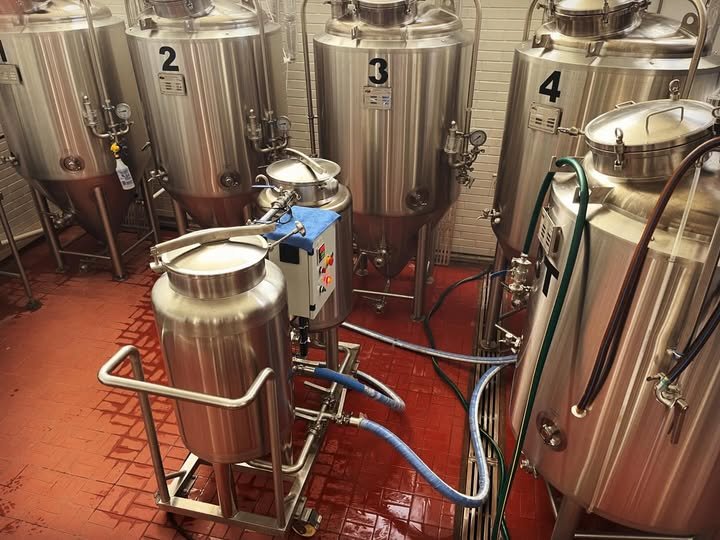
Maintaining a clean brewery is crucial for ensuring the quality of your beer and the longevity of your equipment. If you’re managing a 500L brewery with a 2-vessel brewhouse, understanding how much water is required for an effective cleaning process is key to efficient operations. Generally, cleaning the tank in brewery requires about 1.5 to 2 times its own volume of water. Let’s break down the water usage for cleaning your brewery setup, which includes a 500L 2-vessel brewhouse, 1x1000L hot water tank, 4x1000L fermenters, 1x1000L brite tank, 1x1000L glycol water tank, and a 100L CIP system.
1. Brewhouse Cleaning
The 500L brewhouse, consisting of a mash/lauter tun and a kettle/whirlpool tun, requires a significant amount of water for thorough cleaning. Typically, you will need around 400L to 600L of water per cleaning cycle. This includes:
Rinsing: Removing residual grains and wort.
Caustic Cleaning: Breaking down proteins and sugars.
Acid Rinse: Preventing mineral buildup.
Sanitizing: Ensuring a sterile environment for the next batch.
2. Fermenters Cleaning
Cleaning the 4x1000L fermenters is another substantial part of the cleaning process. Each fermenter usually requires about 750L to 1000L of water, making the total water needed for all fermenters approximately 3000L to 4000L. This water is used for:
Initial Rinse: To remove yeast and beer residues.
Caustic Wash: To clean organic residues.
Acid Rinse: To prevent scale and residue build-up.
Final Rinse and Sanitizing: To ensure no residues remain and equipment is sterile.
3. Brite Tank Cleaning
Your 1000L brite tank will need approximately 750L to 1000L of water for cleaning. The cleaning process includes:
Rinsing: To remove any residual beer.
Caustic Wash: To clean out any organic material.
Acid Rinse: To remove any mineral deposits.
Sanitizing: To prepare the tank for carbonation.
4. Glycol Water Tank Cleaning
Cleaning the 1000L glycol water tank requires about 750L to 1000L of water. This includes:
Rinsing: To remove residual glycol.
Caustic Cleaning: To break down any organic matter.
Final Rinse: To ensure the system is clean and ready for the next batch.
5. CIP System Cleaning
The 100L CIP (Clean-In-Place) system itself will use about 100L to 150L of water per cleaning cycle. This water is used for:
Rinsing: Pre-cleaning the system.
Caustic and Acid Cleaning: To clean and sanitize the system without disassembling it.
Final Rinse: To remove any cleaning agent residues.
Total Water Usage
Combining the water usage for all components, you can estimate the total amount of water needed for a complete cleaning cycle:
- Brewhouse: 400L to 600L
- Fermenters: 3000L to 4000L
- Brite Tank: 750L to 1000L
- Glycol Water Tank: 750L to 1000L
- CIP System: 100L to 150L
Total Estimated Water Usage: 5100L to 7250L
Optimizing Water Usage
To minimize water waste, consider implementing these practices:
Efficient CIP Systems: Use a well-designed CIP system to reduce water usage and improve cleaning efficiency.
Water Recycling: Reuse rinse water where possible, especially for non-critical cleaning stages.
Regular Maintenance: Keep your equipment in good condition to reduce the need for extensive cleaning.
By understanding and managing your water usage effectively, you can maintain a clean, efficient brewing system while also being environmentally conscious.
Any interested information about CIP system or brewery equipment, please feel free to contact us. We would be more than happy to do our best to support you.
Edited by Cassie
E-mail:tiantaibrewery@cnbrewery.com